
Toner is one of the most misunderstood steps in skincare, yet it directly affects hydration, pH balance, breakouts, and how well your entire routine performs. If you grew up using toner, you probably remember it as something that stung, dried your skin out, and was meant to “fix” oil. That approach is outdated and toner, as a skin category has evolved, and it is not just an extra step. Toner is the step that determines how well your entire skincare routine performs. A toner is a liquid step used after cleansing to restore pH, remove residue, and prepare the skin for treatment products.
Where Toner Fits in a Functional Routine
Toner is applied right after cleansing, when the skin is clean but not yet balanced. This is where many routines quietly fall apart. Without restoring hydration, stabilizing the skin, and removing residual product and mineral deposits from water, the skin remains reactive - unsettled and waiting for direction, which ultimately affects how well the next products perform.
A properly formulated toner refines the skin, helps restore its natural pH, and replenishes water balance, creating the conditions for serums and moisturizers to absorb and perform more effectively. Depending on the formula, it can also support a more even-looking tone, calm visible redness, control oil and improve overall skin clarity.
Toner plays a direct role in maintaining skin stability. When this step is missing, or done incorrectly, the skin often feels tight, uneven, or easily irritated, and becomes more prone to imbalance over time.
My Hydrating Toner is designed for sensitive and dehydrated skin, using humectants and water-binding ingredients to restore hydration, support pH balance, and calm reactivity.
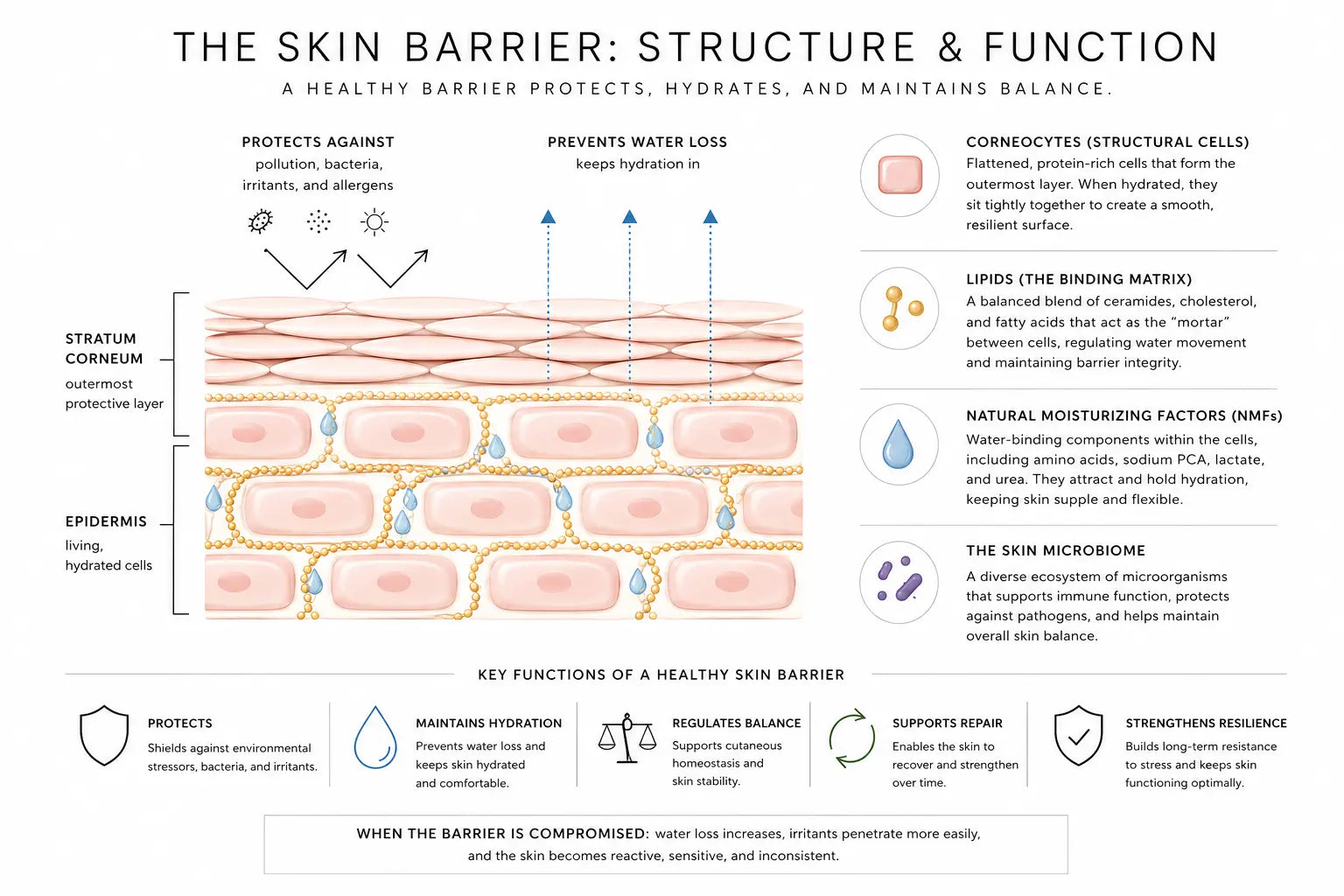
To understand this deeper, read: skin barrier function and repair
Toner is not about doing more. It’s about making the routine work.
The Functions of Toner: Hydration, Clarity, Pigmentation, and Soothing
Most toners fall into two extremes: they either strip the skin or do very little. A properly formulated toner should do much more.
Toner is not a single-purpose step. It supports the skin in four essential ways: hydration, controlled exfoliation, tone correction, oil control and calming.
Hydration: Restoring Balance and Supporting the Skin
If your skin feels dry, tight, or easily irritated, hydration is the first priority.
A hydrating toner for sensitive skin replenishes water content and stabilizes the skin so it can function properly again. My Hydrating Toner uses humectants and water-binding ingredients to restore hydration, support pH balance, and calm reactivity..
My approach focuses on hydration that supports function, not surface-level moisture:
hydrating toner for sensitive and dehydrated skin. My Hydrating Toner is designed for sensitive and dehydrated skin, using humectants and water-binding ingredients to restore hydration, support pH balance, and calm reactivity.
To reinforce that balance and maintain skin stability, follow up with a rich, barrier supporting moisturizer should be applied after the Hydrating Toner to support optimal barrier health.
A hydrating toner:
- Restores water balance after cleansing
- Reduces tightness and sensitivity
- Improves absorption of serums and moisturizers
This is how the skin returns to a functional state.
Controlled Exfoliation: Maintaining Clarity Without Disruption
If your skin is congested, uneven, or breaking out, the goal is not to strip it, it’s to remove buildup in a controlled, consistent way.
The Glycolic Lactic Toner uses low percentages of glycolic and lactic acid, buffered with humectants, allowing for daily exfoliation without disrupting the skin barrier. It's designed for consistent use, including daily use for most skin types, to keep the skin clear without compromising barrier function. An exfoliating toner for acne should remove buildup without triggering irritation or rebound oil.
My formulation focuses on consistency, not aggression
An exfoliating toner:
- Clears buildup and excess oil
- Refines pores and smooths texture
- Improves clarity over time
- Helps with skin discolorations
If exfoliation causes irritation, it’s not improving the skin, it’s disrupting it.
Learn how to recognize this: signs of over-exfoliation and barrier damage.
Pigmentation: Supporting a More Even Skin Tone
Uneven tone, post-breakout marks, and dullness are often linked to buildup and uneven cell turnover. A toner for pigmentation should do more than exfoliate, it should prepare the skin for correction.
The Glycolic Lactic Toner helps address this by gently exfoliating with low levels of acids, allowing the skin to shed more evenly over time. This toner not only helps remove surface buildup, but also improves how pigment-correcting serums penetrate and perform. At the same time, it prepares the skin to better receive pigment-correcting ingredients applied in the next steps.
As buildup is cleared and absorption improves, targeted treatments can work more effectively, leading to a more even-looking complexion over time.
This leads to:
- Brighter, more even-looking skin
- Reduced appearance of post-inflammatory pigmentation
- Improved overall clarity
The key is consistency without irritation, because inflammation can worsen pigmentation.
Soothing: Calming Reactivity and Redness
Skin that is inflamed, sensitized, or overworked does not need more stimulation, it needs calming. Hydrating toners play a critical role here by restoring comfort and preventing the cycle of irritation followed by overcorrection.
A properly formulated toner can:
- Reduce visible redness
- Soothe irritation
- Support recovery after cleansing or treatments
How to Choose the Right Toner for Your Skin
Choosing the right toner is not about trends, it’s about understanding what your skin actually needs.
If your skin feels dry, tight, or easily irritated
Hydration comes first.
A hydrating toner restores stability and allows the skin to return to a functional state. When the barrier is supported, everything that follows performs better.
If your skin is congested, uneven, or breaking out
You need controlled exfoliation.
A properly formulated exfoliating toner helps maintain clarity without triggering inflammation or rebound oil production.
For a more complete approach to breakouts:
how to treat acne without damaging the skin barrier
If your skin feels both dry and breakout-prone (Combination Skin)
This is more common than people think.
Skin can be dehydrated and congested at the same time, and treating only one side often makes the other worse.
The solution is not to overcorrect, but it’s to stay balanced.
For combination skin: you would want to alternate toners.
- A hydrating toner maintains barrier function and soothes reactivity
- An exfoliating toner keeps pores clear while improving uneven tone over time
Alternate based on skin behavior. During peak oil production - typically daytime - use the exfoliating toner to manage buildup and congestion. In the evening, or whenever the skin feels tight, reactive, or depleted, use the hydrating toner to restore balance.
Alternating this way allows you to address both conditions without pushing the skin into stress.
Toner vs Essence: Understanding the Difference
There is often confusion between toner and essence, but they serve different roles.
Essence is a newer skincare category- it’s essentially a diluted, lightweight serum designed to add an extra layer of hydration and treatment.
It is often used on younger, non-problematic skin, where the focus is on maintaining hydration and mild benefits rather than correcting imbalance.
Toner comes first. It prepares the skin by refining, balancing pH, and removing residue, creating the right conditions for absorption.
Essence builds on that foundation, delivering additional hydration and actives into skin that is already receptive.
But, without toner, the skin remains unbalanced, and the rest of the routine - including essence - cannot perform at the same level. For most people, essence is that optional extra step in the routine.
The Bottom Line
Toner is not a one-size-fits-all step.
It is the step that defines how your routine performs.
Most skin needs both hydration and exfoliation, just not at the same time.
When your toner is right:
- Your skin feels stable
- Your barrier remains intact
- Your tone appears more even
- Your skin is calmer and more predictable
- Everything you apply after works better
Explore the Toner Collection and choose based on what your skin needs.
What does toner do for the skin?
Toner restores balance after cleansing. It helps remove residual product and mineral deposits from water, supports the skin’s natural pH, and replenishes hydration. This allows the skin to become more stable and improves how well serums and moisturizers absorb and perform.
Can you use toner every day?
Yes - if the formula is correct. A hydrating toner can be used daily to maintain barrier function and reduce reactivity. An exfoliating toner can also be used daily when it contains low percentages of acids buffered with humectants, allowing for consistent exfoliation without irritation for most skin types.
Is toner necessary?
Toner is not optional if you want your routine to work properly. Without it, the skin often remains unbalanced after cleansing, which affects hydration, increases reactivity, and limits how well treatment products perform. Toner is the step that prepares the skin so everything that follows works as intended.